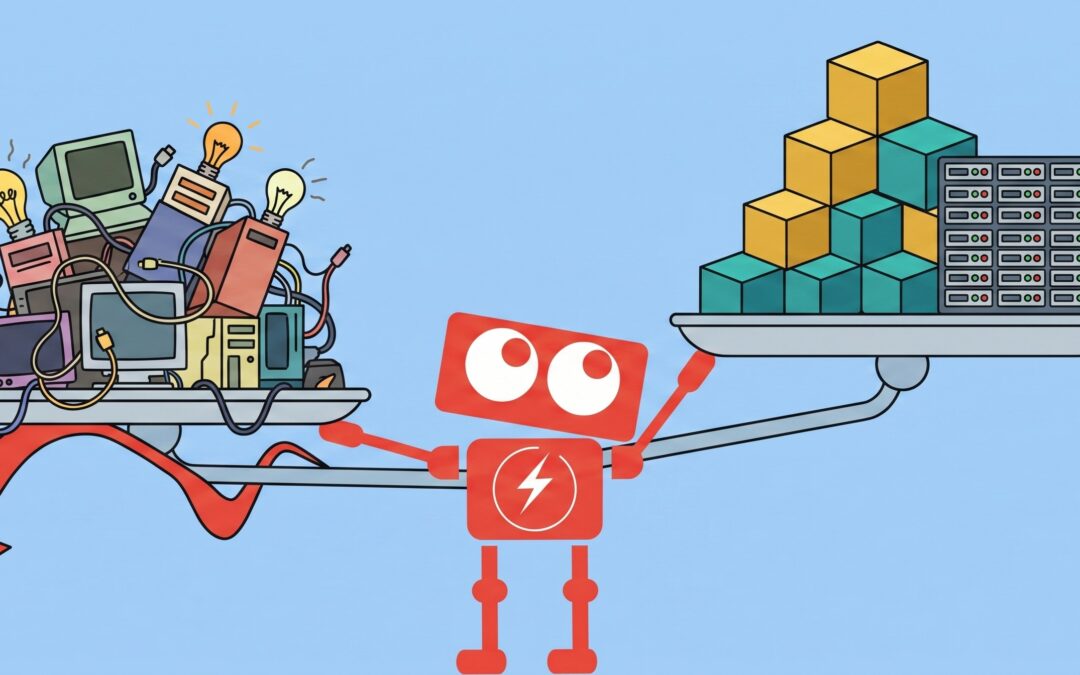
A business owner preparing for a sale may spend months reviewing revenue, profit margins, customer concentration, contracts, and staffing. Technology often receives far less attention.
That can change quickly once a buyer begins due diligence.
Suddenly, questions appear about cybersecurity, software licensing, backups, access controls, business continuity, documentation, and the age of critical systems. What seemed like routine internal IT can become part of a much larger question.
How much risk is a buyer actually acquiring?
For small and midsize businesses, IT maturity can influence business valuation because technology now touches nearly every part of operations. A company with dependable systems, documented processes, and manageable technology risk is generally easier to understand, transfer, and operate than one relying on outdated equipment, informal processes, or knowledge held by a few employees.
IT maturity does not determine the value of a business by itself. It can, however, influence how confidently someone views that value.
IT Risk Can Become Business Risk During Due Diligence
Buyers are not simply purchasing revenue. They are purchasing the systems required to continue producing that revenue.
Consider a 60-employee professional services company with strong financial performance. Its customer relationships are stable, employees are experienced, and revenue has grown consistently.
During technical due diligence, however, the buyer discovers that several critical applications run on aging servers. Backups exist, but restoration has never been tested. Administrative passwords are shared among employees, and there is little documentation explaining how systems are configured.
None of these issues necessarily means the company is poorly run. They do create uncertainty.
A buyer may begin wondering how much investment will be required after the transaction. Could systems fail during the transition? Are there cybersecurity weaknesses that have not been identified? Could an employee departure interrupt access to important technology?
That uncertainty can affect negotiations.
Technology problems may result in additional due diligence, requests for remediation before closing, money reserved for future upgrades, or adjustments to how the buyer evaluates operational risk.
The key issue is not whether the company has perfect technology. Few businesses do.
The issue is whether technology risk is understood and controlled.
Mature IT Makes a Business Easier to Transfer
One of the most important questions in any acquisition is whether the company can continue operating smoothly when ownership changes.
Mature IT environments tend to make that transition easier.
Important systems are documented. Software subscriptions and licenses are understood. Employee access can be added or removed systematically. Vendors and technology responsibilities are clearly identified. Backups are tested. Security policies are defined. Critical systems are not dependent on one employee remembering how everything works.
This creates operational continuity.
Imagine two companies with similar revenue and profitability.
The first company currently has an inventory of computers, software, cloud services, administrators, vendors, and system documentation. The buyer can quickly understand how the technology environment works.
The second company relies heavily on an employee who has managed technology informally for years. There is limited documentation, several unknown software subscriptions, and no reliable inventory of administrative accounts.
Financially, the businesses may look similar.
Operationally, they present very different transition risks.
This is one reason IT maturity can matter during a business sale. Organized technology reduces the number of unknowns a buyer must investigate.
Cybersecurity Posture Can Influence Buyer Confidence
Cybersecurity has increasingly become part of business valuation discussions because a security problem can create financial, legal, and operational consequences.
Buyers may examine whether a company uses practices such as multifactor authentication, endpoint security, employee security training, access controls, reliable backups, and regular software updates.
They may also look for evidence that former employees lose access promptly and that sensitive information is limited to people who actually need it.
These controls are not simply technical preferences. They help demonstrate that the company manages digital risk intentionally.
For example, imagine a buyer discovers that dozens of employees still have broad administrative access to company systems.
That creates questions.
Why is the access necessary? Who reviews permissions? What happens when employees leave? Could sensitive information be exposed accidentally?
A mature IT environment can answer those questions with clear processes rather than assumptions.
The goal is not to prove that a cyber incident could never happen. No organization can guarantee that.
The goal is to demonstrate that reasonable safeguards are in place and that the company knows how it would respond if something went wrong.
That distinction can strengthen confidence during technical due diligence.
Technology Debt Can Reduce the Quality of Future Earnings
Business valuation often focuses heavily on future earnings.
Technology can affect those earnings in ways that are easy to overlook.
A company might currently be profitable while postponing necessary technology investments. Older servers may still be functioning. Unsupported software may still run. Manual processes may still work because employees have learned complicated workarounds.
Eventually, those decisions can create what is often called technology debt.
Technology debt is the accumulated cost and complexity created when necessary improvements are delayed.
A buyer evaluating a company may ask whether significant technology spending will be required soon after acquisition.
Will computers need replacement? Will outdated software need migration? Are important systems approaching the end of vendor support? Will cybersecurity controls need substantial improvement?
If the answers suggest considerable future work, those costs may influence how the buyer evaluates expected returns.
By contrast, a company with a reasonable technology lifecycle is easier to forecast.
Systems do not need to be brand new. They simply need to be managed intentionally.
IT Maturity Can Reveal How Well the Business Operates
Technology maturity often reflects something broader than the IT environment itself.
It can reveal how disciplined the organization is.
Businesses with mature technology practices usually know which systems they depend on, who owns important responsibilities, how access is managed, what happens during an outage, and how critical information is protected.
Those habits often overlap with strong operational management.
This is why improving IT maturity can create benefits long before a sale is considered.
Better documentation reduces dependence on individual employees. Tested backups improve resilience. Standardized systems simplify employee onboarding. Clear access controls reduce unnecessary risk. Technology planning makes future expenses more predictable.
These improvements can make the company easier to operate today while also making it easier for someone else to understand tomorrow.
What IT Areas Do Buyers Commonly Review?
Every transaction is different, but technology due diligence may examine areas such as:
• Hardware and software inventories
• Cybersecurity controls
• Backup and disaster recovery processes
• Cloud services and software subscriptions
• User accounts and administrative privileges
• Software licensing
• Technology contracts and vendors
• System documentation
• Data privacy practices
• Business continuity planning
• Unsupported or outdated technology
The purpose is usually not to find a flawless environment. It is to understand the technology required to operate the business and identify risks that may require attention.
Stronger IT Maturity Creates Fewer Surprises
Technology rarely appears as a single line on a business valuation report.
Its influence is often more subtle.
IT maturity can affect operational risk, transition complexity, cybersecurity exposure, future investment requirements, and confidence in the company’s ability to continue operating reliably.
For business owners, this creates a useful way to think about technology.
IT should not only support today’s employees. It should also make the organization understandable, resilient, and transferable.
A business with documented systems, manageable technology debt, tested recovery processes, and sensible security controls gives stakeholders a clearer picture of how the company operates.
That clarity matters whether a sale is five years away, one year away, or not currently being considered at all.
Business leaders who want to understand their current position can start with a simple IT maturity assessment. Reviewing technology documentation, security controls, system age, backup readiness, and operational dependencies can reveal where the organization is already strong and where greater maturity could improve long-term business value.